I'm pretty happy with my new end fed antenna. Using it Friday evening through yesterday afternoon I've worked NM, PA and OH on 20 and OH and TX on 30. All on CW from my back deck and 5 watt KX3. While not foreign DX, the contacts have been easy to make. Most answered my CQs. Keep in mind also that most of this time band conditions were poor because of a solar flare/storm.
This one is replacing the 58' wire in my KX3 travel bag.
Monday, June 18, 2012

Friday, June 15, 2012
Another Portable Antenna
Tonight I got on the air with my latest endfed wire and had good success working both New Mexico and Pennsylvania.
I've been concerned about running a non-resonant endfed 58' wire with a single counterpoise laying on the ground. It sort of felt like an off center fed windom with half of the antenna on the ground.
I put together a 20 mtr end fed zepp (14'3" of TV twin lead with the hot side feeding 33'3' of wire) and arranged it as a sloper with the KX3/feedpoint on my deck about 8' off the ground, the twin lead/wire connection about 20' off the ground, and the far end of the antenna about
  1' off the ground. Now the ground side of the antenna system is up in the air rather then laying on the ground. It seems to work pretty good on 20 and as a bonus the KXAT3 antenna tuner can also load it
  up on 40, 30, 17 and 10. (Not the most efficient radiator on these "bonus" bands but if I can make contacts it is good enough). The reverse beacon system at http://www.reversebeacon.net says I'm getting out.
Besides set up as a sloper (more or less) this antenna can be deployed as an inverted V, an inverted L or a vertical...mostly how ever is convenient to get some part of it up in the air. The 33' 3"portion of mine is Radio Shack insulated 18 gauge stranded copper wire. It runs over tree limbs just fine. Unfortunately Radio Shack no longer sells the light weight twin lead that I used...but any twin lead or ladder line will work but the 14'3"length will need to be adjusted depending on the twin lead velocity factor.
(Just an additional note....where did 33'3" and 14'3" come from?
What I have is a 20mtr EFHW with a quarter wave matching section. At 14.060 MHz a EFHW is 468/14.060 or 33.3'. Even the KX3 ATU can't match this 33'3" wire directly, it is too high of an impedance. The quarter wave matching section transforms the high impedance feedpoint of the EFHW to a lower impedance that the KX3 can handle. At 14.060MHz a quarter wave is 246/14.060 or 17'6". Assuming a velocity factor of 80% gets the length to 14'3". )
(Something else, the KXAT3/tuner is still needed, even on 20. Nothing's perfect and the twin lead quarter wave matching section can only be said to transform high impedance to low impedance. How high and how low changes with how/where this antenna is deployed. The KXAT3/tuner covers the variable.)
I've been concerned about running a non-resonant endfed 58' wire with a single counterpoise laying on the ground. It sort of felt like an off center fed windom with half of the antenna on the ground.
I put together a 20 mtr end fed zepp (14'3" of TV twin lead with the hot
 side feeding 33'3' of wire) and arranged it as a sloper with the KX3/feedpoint on my deck about 8' off the ground, the twin lead/wire connection about 20' off the ground, and the far end of the antenna about
  1' off the ground. Now the ground side of the antenna system is up in the air rather then laying on the ground. It seems to work pretty good on 20 and as a bonus the KXAT3 antenna tuner can also load it
  up on 40, 30, 17 and 10. (Not the most efficient radiator on these "bonus" bands but if I can make contacts it is good enough). The reverse beacon system at http://www.reversebeacon.net says I'm getting out.
Besides set up as a sloper (more or less) this antenna can be deployed as an inverted V, an inverted L or a vertical...mostly how ever is convenient to get some part of it up in the air. The 33' 3"portion of mine is Radio Shack insulated 18 gauge stranded copper wire. It runs over tree limbs just fine. Unfortunately Radio Shack no longer sells the light weight twin lead that I used...but any twin lead or ladder line will work but the 14'3"length will need to be adjusted depending on the twin lead velocity factor.
(Just an additional note....where did 33'3" and 14'3" come from?
What I have is a 20mtr EFHW with a quarter wave matching section. At 14.060 MHz a EFHW is 468/14.060 or 33.3'. Even the KX3 ATU can't match this 33'3" wire directly, it is too high of an impedance. The quarter wave matching section transforms the high impedance feedpoint of the EFHW to a lower impedance that the KX3 can handle. At 14.060MHz a quarter wave is 246/14.060 or 17'6". Assuming a velocity factor of 80% gets the length to 14'3". )
(Something else, the KXAT3/tuner is still needed, even on 20. Nothing's perfect and the twin lead quarter wave matching section can only be said to transform high impedance to low impedance. How high and how low changes with how/where this antenna is deployed. The KXAT3/tuner covers the variable.)
Monday, June 4, 2012
KX3 and a Boat Anchor Amp

A year ago, in a rare foreshadowing of radios to come, I acquired a linear amplifier
 built around a single 572B running
 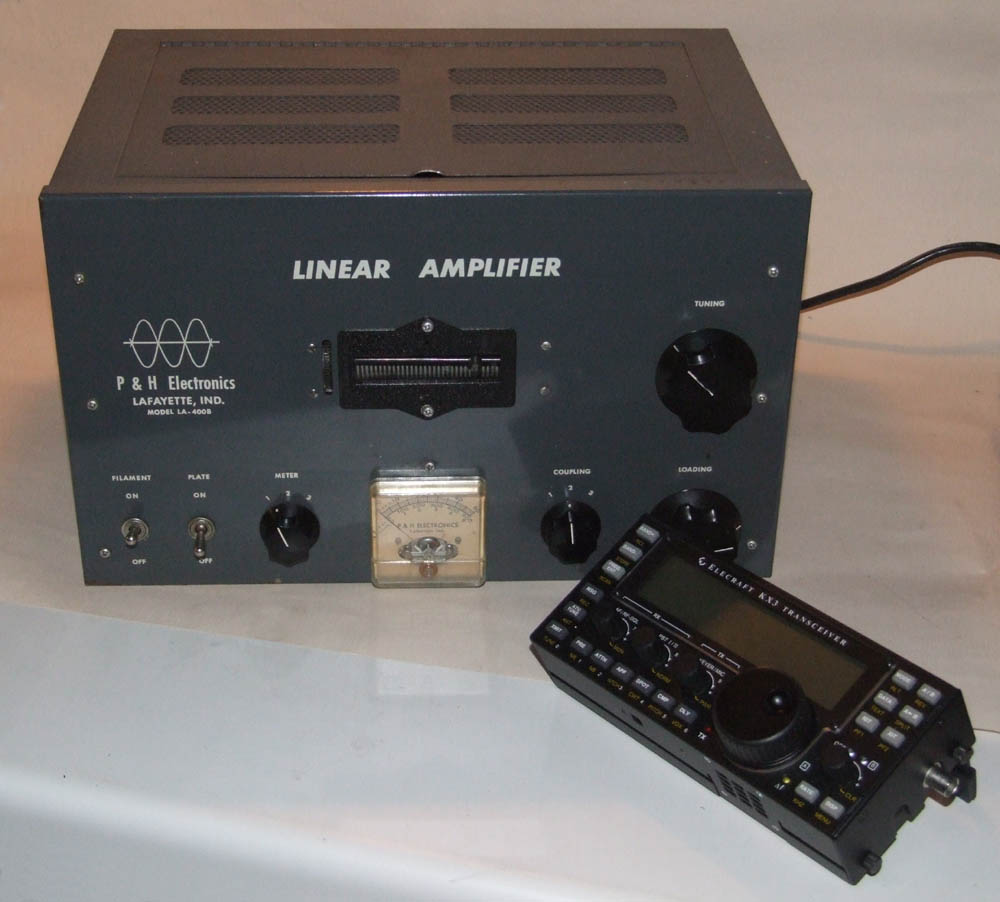 grounded grid. It matched my Central Electronics 20A and the seller
 had done really nice job of replacing the four original/modified 1625s in the P&H Electronics LA-400B with a 572B.
Now, seeing it in my shack, I realize that I have a potential May-December wedding here. Sure enough, my KX3 with KXAT3 easily drives the 572B to 100 watts out. The next step is to build a relay box that bypasses the amplifier and delivers -100VDC cutoff bias on receive. It can be controlled via the KX3 Keyline Out signal and a "Keyall" board from Jackson Harbor Press/WB9KZY.
 At 35 pounds this one will be a heavy weight. I doubt it will see any picnic table operating but it will certainly help warm up the shack next winter.
Monday, May 14, 2012
New KX3 QSL Card
It's a new "QRP in the Park" season and I have a new rig. I need a new QSL card.
My new card, using Walmart digital photo printing and 3.3"x4" Avery shipping la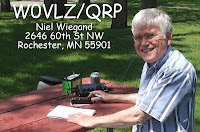 bels, costs about $.30 each in single quantities. This is a great match for my operating style. Rarely do I get on the air and work 100s (or even 10s) of hams in a short time. It would take me forever to work through 100 or more pre-printed QSL cards. This way I can make up QSL cards 5-10 at a time and easily update them without throwing out a bunch of unused cards.
Interested in doing the same? See my January 2, 2010 blog entry.
My new card, using Walmart digital photo printing and 3.3"x4" Avery shipping la
 bels, costs about $.30 each in single quantities. This is a great match for my operating style. Rarely do I get on the air and work 100s (or even 10s) of hams in a short time. It would take me forever to work through 100 or more pre-printed QSL cards. This way I can make up QSL cards 5-10 at a time and easily update them without throwing out a bunch of unused cards.
Interested in doing the same? See my January 2, 2010 blog entry.
Sunday, May 13, 2012
KX3 in Silver Lake Park
Today the weather finally turned warm, sunny and dry. It was also Mother's Day, a good reason to avoid the restaurants for a picnic in the park. I did get a chance, though, before the picnic to practice my favorite operating pastime. I found several signals on 20 mtr CW. Gary, K5ON, answered my CQ. We had a great QSO. The KX3 again performed great....love that roofing filter.
Sunday, May 6, 2012
Packing my Elecraft KX3 for a trip
I'm getting ready for summer trips and outings with my Elecraft KX3. I found a the right size padded bag at Goodwill for $3.00. See my video at KX3PicnicTableQRPPack
Monday, April 16, 2012
Elecraft KX3 is here!

Today I was at the Rochester, MN UPS depot at 10AM sharp to pick up my new radio. I got serial number 43 of, I expect, thousands. Elecraft has crammed a lot into a small box. I spent most of the day figuring out how to use it.
One QSO so far. KB5AE in Ada, OK answered my CQ on 20 CW. He reported a fine 579 signal down his way.
Saturday, February 4, 2012
TZ-20 Amp Output Circuit
This morning I was showing off photos of my TZ-20 amplifier  when one of my friends commented that it certainly was wireless, just look at the one rotatory switch with no wires attached to it. This reminded me that I had one last update to post on this project.
After WWII almost every transmitter project (except the simplest starter sets) had a pi network output stage. This was not as common in the 30s. Most transmitters then had link coupled output followed be some sort of antenna matching network. Many times the matching "network" was a variable capacitor either in series or parallel with the output link. A series capacitor worked best for low impedance loads while a parallel capacitor was used to feed into high impedance loads. Today's norm is a 50 ohm antenna antenna/coax system requiring a series capacitor.
SW3, a rotatory switch, controls course loading. C5 is the fine loading adjustment. With SW3 I can switch out the series capacitor all together or add in additional capacitance to give me a total range from about 20pF to 900pF. Tune up becomes very much like a pi network "dip and load". With SW3 and C5 set for minimum capacitance the plate current is dipped using C4. After dipping, the loading capacitance is increased using C5, C6 and C7 into the range of operating plate current and then the current redipped using C4. C4, C5, C6 and C7 interact so this process must be repeated until the last C4 adjustment puts the plate current where it needs to be for full output...in my case about 150 mA. 500 VDC on the TZ-20 plates at 150 mA gives me 75 watts input.
 when one of my friends commented that it certainly was wireless, just look at the one rotatory switch with no wires attached to it. This reminded me that I had one last update to post on this project.
After WWII almost every transmitter project (except the simplest starter sets) had a pi network output stage. This was not as common in the 30s. Most transmitters then had link coupled output followed be some sort of antenna matching network. Many times the matching "network" was a variable capacitor either in series or parallel with the output link. A series capacitor worked best for low impedance loads while a parallel capacitor was used to feed into high impedance loads. Today's norm is a 50 ohm antenna antenna/coax system requiring a series capacitor.
SW3, a rotatory switch, controls course loading. C5 is the fine
 loading adjustment. With SW3 I can switch out the series capacitor all together or add in additional capacitance to give me a total range from about 20pF to 900pF. Tune up becomes very much like a pi network "dip and load". With SW3 and C5 set for minimum capacitance the plate current is dipped using C4. After dipping, the loading capacitance is increased using C5, C6 and C7 into the range of operating plate current and then the current redipped using C4. C4, C5, C6 and C7 interact so this process must be repeated until the last C4 adjustment puts the plate current where it needs to be for full output...in my case about 150 mA. 500 VDC on the TZ-20 plates at 150 mA gives me 75 watts input.
Sunday, January 22, 2012
AWA 2012 Linc Cundall OT CW Contest
This afternoon I wrapped up my participation in this year's Linc Cundall OT CW Contest.  Obviously I'm not a major contester. During the 48 hour contest I netted nine contacts. Not many contacts/points but I did enjoy putting my latest homebrew transmitter on the air.
This year I used my new "Taylor 75", a 1934 style oscillator-buffer deck driving two Taylor TZ-20s in push-pull. The receiver was a National NC-101X. Everyone that commented indicated that the transmitter sounded fine. Keying the buffer stage helped. With the crystal oscillator running continuously (on transmit) there was no sign of chirp.
I went ahead and created a QSL card to send out.
 Obviously I'm not a major contester. During the 48 hour contest I netted nine contacts. Not many contacts/points but I did enjoy putting my latest homebrew transmitter on the air.
This year I used my new "Taylor 75", a
 1934 style oscillator-buffer deck driving two Taylor TZ-20s in push-pull. The receiver was a National NC-101X. Everyone that commented indicated that the transmitter sounded fine. Keying the buffer stage helped. With the crystal oscillator running continuously (on transmit) there was no sign of chirp.
I went ahead and created a QSL card to send out.
Saturday, January 14, 2012
On the Air
Today I got on both 80 and 40 using my new 75 watt transmitter. This afternoon I had a nice QSO on 40 with KC9RXI, Tom, in West Salem, WI and this evening on 80 with NS7E, Art, in New Prague, MN. Both Art and Tom reported no problem with my signal.
Tremendous!
Tremendous!
Subscribe to:
Posts (Atom)