I think I have enough to get started....
The tough part to find was the dual 500 pf Cardwell capacitor. I found one by putting my need out on the AWA Group Yahoo group. What I now have isn't exactly what QST called for but should be close enough. A trip to Menards got me wood for a base. I'll need to pay a visit to a friend with a table saw. Copper tuning I should be able to find locally at Menards, Lowes or Home Depot. The small
parts under the "chassis" I should have on the shelf.
Next step is to cut and varnish the base.
Monday, January 14, 2019
Sunday, January 13, 2019
Push-Pull Colpitts Transmitter - 1
I’ve started on a new transmitter for the next AWA Bruce Kelley
1929 QSO Party. The “BK” requires non-crystal-controlled transmitters that are
of 1920s design and use tube types that were available in 1929. I found a
transmitter described in the January 1934 issue of QST that meets these
requirements.
For a good over view of the transmitters built to be used in
the BK take a look at VE7SL’s gallery page at https://qsl.net/ve7sl/29gallery.html
. Of the 65 transmitters 48 are either Hartleys or TNTs. The next one in
the list was the TPTG with 9. Only 2
were Colpitts. I have TNT and Hartley transmitters for the BK and a TPTG is a lot
like a TNT so building a Colpitts for the BK sounds like a good next choice. This
will round out my 1920s “big three”.
The 1934 QST article lists several features of this design
that sound attractive:
Antenna coupling to
the non-plate portion of the tank coil. The more common link coupling to
the plate ends of the tank coil results in more second harmonic output and less
frequency stability when the antenna is tightly coupled for maximum output.
Center/swinging link coupling should be an improvement.
Push-pull tube capacitance
in series. Temperature changes within the tubes that impact the
interelectrode capacities will have less impact on frequency stability. This
configuration also reduces the amount of current through the tubes.
Symmetric layout.
A symmetric layout is less prone to exhibit signal instability
Grounded tuning capacitor
body. In this design the tank tuning capacitor body provides shielding so
that hand capacity has less of an impact on frequency. This transmitter should
be easier to get on frequency.
Easily converted to
an amplifier. If I decide to move on to a MOPA BK rig this will be one
section that I already have.
In addition to information about this particular transmitter
design, this QST article also gives hints that are useful for any 20s
transmitter:
Use a
well-regulated/stiff power supply
Route power and
antenna cables away from the transmitter
Do not place the power
supply close to the transmitter
Now, may the parts hunt begin!
Monday, December 31, 2018
Handbooks on the web
Several ARRL (and Radio) Handbooks can be downloaded from the web ...
1976: https://ia800401.us.archive.org/27/items/RadioAmateurHandbook1976/radio-amateur-handbook-1976.pdf
1941: https://www.scribd.com/document/91745963/The-Radio-Amateur-s-Handbook-1941
1936: http://www.smcelectronics.com/DOWNLOADS/1936%20ARRL%20HANDBOOK.pdf
1931: https://ia802807.us.archive.org/6/items/Amateur_Radio_Handbok_-_ARRL_1931/Amateur_Radio_Handbok_-_ARRL_1931.pdf
Many years of the "Radio Handbook" are at https://www.americanradiohistory.com/Radio_Handbook.htm
For ham radio magazines including QST, CQ and Ham Radio go to americanradiohistory.com . In the upper right corner click on DX logs – SW Ham. From there you will see many many classic radio magazines that you can download.
1976: https://ia800401.us.archive.org/27/items/RadioAmateurHandbook1976/radio-amateur-handbook-1976.pdf
1941: https://www.scribd.com/document/91745963/The-Radio-Amateur-s-Handbook-1941
1936: http://www.smcelectronics.com/DOWNLOADS/1936%20ARRL%20HANDBOOK.pdf
1931: https://ia802807.us.archive.org/6/items/Amateur_Radio_Handbok_-_ARRL_1931/Amateur_Radio_Handbok_-_ARRL_1931.pdf
Many years of the "Radio Handbook" are at https://www.americanradiohistory.com/Radio_Handbook.htm
For ham radio magazines including QST, CQ and Ham Radio go to americanradiohistory.com . In the upper right corner click on DX logs – SW Ham. From there you will see many many classic radio magazines that you can download.
Monday, December 10, 2018
Further 6J5/6L6 Transmitter Developments
My shack continues to be in a state of flux, Nothing is built just once. As I rethink things, stuff is added or changed.
In this case I decided to pair my 6J5/6L6 transmitter up with my HRO Sr rather than my Simple Superhet. I wanted something of the right design vintage and looks to sit next to my HRO while running either barefoot or driving my TZ-20 amp. The core design of my 6J5/6L6 transmitter is right out of a 1940 Stancor manual so the design was fine. It just didn't look like it belonged with the HRO Sr. What I did was a cosmetic change replacing the front panel and then repackaging the transmitter in a metal cabinet.
If I ever need a more upscale transmitter in that spot I have a Meissner Signal Shifter waiting in the wings.
In this case I decided to pair my 6J5/6L6 transmitter up with my HRO Sr rather than my Simple Superhet. I wanted something of the right design vintage and looks to sit next to my HRO while running either barefoot or driving my TZ-20 amp. The core design of my 6J5/6L6 transmitter is right out of a 1940 Stancor manual so the design was fine. It just didn't look like it belonged with the HRO Sr. What I did was a cosmetic change replacing the front panel and then repackaging the transmitter in a metal cabinet.
If I ever need a more upscale transmitter in that spot I have a Meissner Signal Shifter waiting in the wings.
Sunday, December 9, 2018
Novice Bookends
Many identify the Novice Class between 1951 (when it was introduced) and the early 70s (when VFOs, 250 watts and renewable licenses became part of the novice license) as the golden or classic era for novices. During the 50s and 60s the novice class was clearly a learner class. During this time amateur radio manufacturers marketed rigs specifically designed for novices.
I have two that I would call bookends to this classic era. One is the Hallicrafters SR75 introduced in 1951 just as the Novice Class was introduced and the other is the Heathkit HW16 (1967-1976). Both of these are transmitter/receivers in the same case with features and capabilities that match the restrictions of the
Novice Class. Hallicrafters chose the add a crystal oscillator to a S38B along with circuitry using the 50L6 audio amp as the transmitter final. The resulting rig looks, from the front, almost exactly like a S38B. Performance and usability would have been disappointing.The transmitter was only rated for 10 watts and changing bands or the crystal required removing the back of this AC/DC set. Also the SR75 receiver section was basically a S38B, an entry level receiver that many beginners would already have had. In addition the price delta between the S38B and SR75 was $40. Several crystal controlled transmitters were on the market in the early fifties in this price range that would have looked better to the novice and he could build his own transmitter even cheaper. By the time Heathkit tackled this particular niche in the mid 60s they designed a rig from the ground up that had features better tuned for the novice.
Two bookends on an era but Heathkit did a better job. I'm using my HW16 while the SR75 remains a shelf queen good for discussion.
I've uploaded more SR75 information to www.prismnet.com/~nielw/SR75/
I have two that I would call bookends to this classic era. One is the Hallicrafters SR75 introduced in 1951 just as the Novice Class was introduced and the other is the Heathkit HW16 (1967-1976). Both of these are transmitter/receivers in the same case with features and capabilities that match the restrictions of the
Novice Class. Hallicrafters chose the add a crystal oscillator to a S38B along with circuitry using the 50L6 audio amp as the transmitter final. The resulting rig looks, from the front, almost exactly like a S38B. Performance and usability would have been disappointing.The transmitter was only rated for 10 watts and changing bands or the crystal required removing the back of this AC/DC set. Also the SR75 receiver section was basically a S38B, an entry level receiver that many beginners would already have had. In addition the price delta between the S38B and SR75 was $40. Several crystal controlled transmitters were on the market in the early fifties in this price range that would have looked better to the novice and he could build his own transmitter even cheaper. By the time Heathkit tackled this particular niche in the mid 60s they designed a rig from the ground up that had features better tuned for the novice.Two bookends on an era but Heathkit did a better job. I'm using my HW16 while the SR75 remains a shelf queen good for discussion.
I've uploaded more SR75 information to www.prismnet.com/~nielw/SR75/
Saturday, December 8, 2018
Winter 2018/19
After missing the AWA Bruce Kelley 1929 CW Party I'm looking forward to the vintage ham radio opportunities still coming up over the next few months:
ARRL Straight Key "Night" (Any equipment, Any band CW) Jan 1
http://www.arrl.org/straight-key-night
AWA Linc Cundall (pre 1951, 160/80/40 CW) Jan 2-6
http://www.antiquewireless.org/event-details-for-lc-cw-contest.html
Novice Rig Roundup (xtal control and less than 75W, 80/40/15/10 CW, 2 AM) Mar 2-10
http://novicerigroundup.com/
AWA John Rollins (pre 1960, 40/20 CW) Mar 13-17
http://www.antiquewireless.org/event-details-for-john-rollins-dx-contest.html
Novice Rig "Night" (80/40/15/10 CW) Every Monday
http://novicerigroundup.com/novicerignight.html
I've six stations that I should have on the air for these events.
These will all be a great activities for those long cold Minnesota nights I'm expecting.
ARRL Straight Key "Night" (Any equipment, Any band CW) Jan 1
http://www.arrl.org/straight-key-night
AWA Linc Cundall (pre 1951, 160/80/40 CW) Jan 2-6
http://www.antiquewireless.org/event-details-for-lc-cw-contest.html
Novice Rig Roundup (xtal control and less than 75W, 80/40/15/10 CW, 2 AM) Mar 2-10
http://novicerigroundup.com/
AWA John Rollins (pre 1960, 40/20 CW) Mar 13-17
http://www.antiquewireless.org/event-details-for-john-rollins-dx-contest.html
http://novicerigroundup.com/novicerignight.html
I've six stations that I should have on the air for these events.
| HRO Sr / 6J5-6L6 + TZ20 Amp |
| Simple Super / Utah Jr |
| FB7 / CW25Jr |
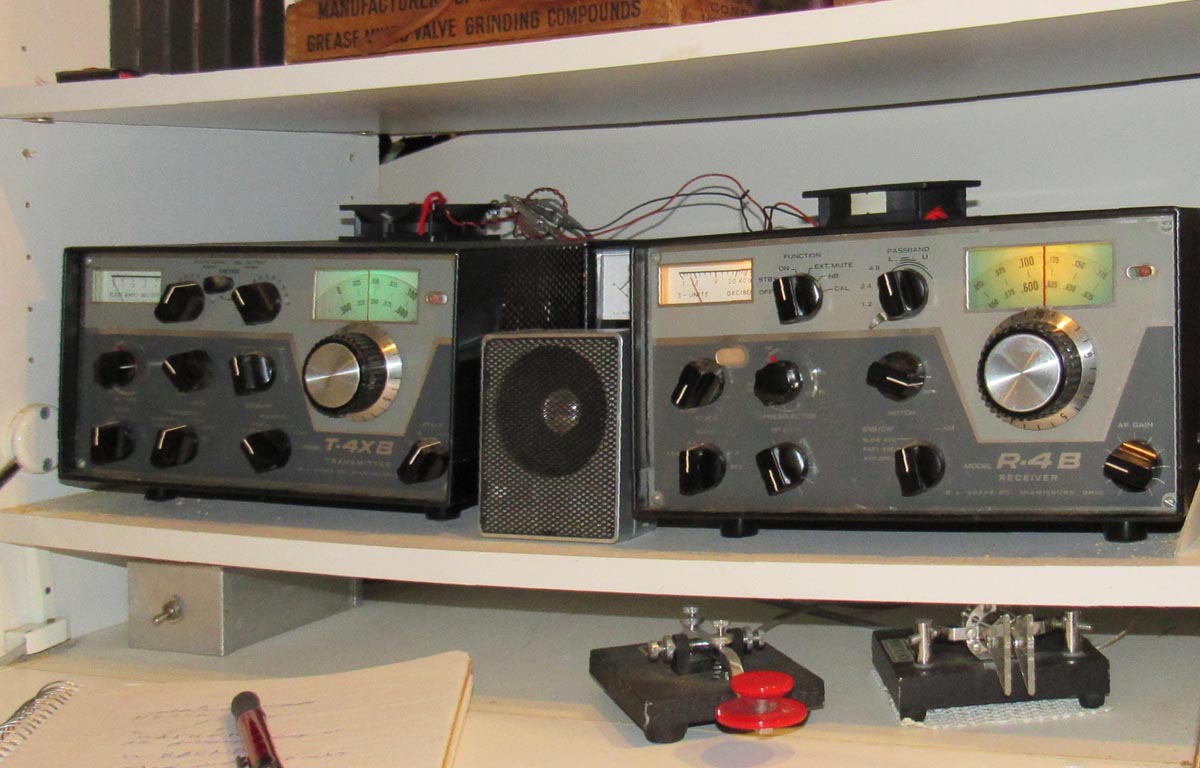
| R4B / TX4B Drake Twins |
| NC-303 / HW16 |
| Drake 2B / Eico 720 |
These will all be a great activities for those long cold Minnesota nights I'm expecting.
Wednesday, September 19, 2018
Winter 2018-19 Boat Anchor Season
As summer wraps up here and turns into fall I start shifting from QRP-In-The-Park to Boat-Anchors-In-The-Basement and the
winter contest/operating event season. One station in the works here is a moderate capability mid 30s CW setup using a couple of TZ-20s (at about 50
watts) in the final and a National FBX-A receiver. It qualifies nicely
for the AWA Linc Cundall Memorial CW Contest.
I've now finished up the transmitter power supply so I'll soon be testing it out on the air. The transformer is rated for 560V at 270mA so should certainly easily handle my 50-70W transmitter. At 31 pounds, mostly iron, I don't plan to move this one around much.
Next on the to-do list is to go through the FBX-A getting it on the air.
I've now finished up the transmitter power supply so I'll soon be testing it out on the air. The transformer is rated for 560V at 270mA so should certainly easily handle my 50-70W transmitter. At 31 pounds, mostly iron, I don't plan to move this one around much.Next on the to-do list is to go through the FBX-A getting it on the air.
Friday, September 7, 2018
EF Johnson 50th Speech
Here is an audio file/recording of Edgar F. Johnson speaking on the
1973 50th anniversary of his company. He covers the early history of
radio and then (starting at 8 minutes into the recording) how EF Johnson
has grown: https://youtu.be/kenWgEF_zUM
Wednesday, September 5, 2018
The Western Historic Radio Museum
As I was looking for more information about my NC-81X I found the Western Historic Radio Museum. This is a great resource providing all sorts of interesting information and restoration tips.
Take a look at https://www.radioblvd.com/
National pages are at
https://www.radioblvd.com/National%20HRO.htm
and
https://www.radioblvd.com/NC100.htm
Take a look at https://www.radioblvd.com/
National pages are at
https://www.radioblvd.com/National%20HRO.htm
and
https://www.radioblvd.com/NC100.htm
National NC-81X
I've gotten my NC-81X back on the air! It is paired with my Stancor 10P for a mid-class 1939 AM/CW station. I'm using it on 40 and 80 meter CW.
The NC-81X sat in the National receiver price lineup below the NC-101XA. Comparing the two, the NC-81X had transformerless AC/DC power, no S-Meter and no RF stage but I found it really performs pretty good. Shifting the IF to 1560KC helped eliminate any image problem.
Along the way to adding it to my station lineup I did change a few things. First the obvious one, I changed out all of the paper and electrolytic caps. I left the original electrolytics in place but replaced them with modern electrolytics mounted under the chassis. I'm not a fan of transformerless AC/DC receivers and this one had a short between the chassis and the metal case. Unless run with an isolation transformer it was a shock hazard waiting to happen. I had a small isolation transformer big enough to handle the NC-81X B+ requirements so I wired it into the receiver to supply B+ and I left the filament string connected across 120 VAC. I addition I fused each side of the AC line and added a three wire/grounded cord. Now this radio is safe to use but repair work under the chassis still requires a "real" isolation transformer. The NC-81X is not an HRO though. While very usable it still tends to FM/wobble on strong CW signals. I suspect the B+ needs to be regulated.
The 1938 list price for the NC-81X was $165 while the NC-101X listed for $215. This was back when the US average wages per year was $1,730 compared to about $60,000 today. I bet 10% of my wages towards a new radio would lead to some interesting dinner time conversation. No wonder National introduced the NC-44 at an even lower price point ($82.50) and by 1939 dealers sold these radios at a very steep discount (NC-101X for $129 and NC-81X for $99).
The NC-81X sat in the National receiver price lineup below the NC-101XA. Comparing the two, the NC-81X had transformerless AC/DC power, no S-Meter and no RF stage but I found it really performs pretty good. Shifting the IF to 1560KC helped eliminate any image problem.Along the way to adding it to my station lineup I did change a few things. First the obvious one, I changed out all of the paper and electrolytic caps. I left the original electrolytics in place but replaced them with modern electrolytics mounted under the chassis. I'm not a fan of transformerless AC/DC receivers and this one had a short between the chassis and the metal case. Unless run with an isolation transformer it was a shock hazard waiting to happen. I had a small isolation transformer big enough to handle the NC-81X B+ requirements so I wired it into the receiver to supply B+ and I left the filament string connected across 120 VAC. I addition I fused each side of the AC line and added a three wire/grounded cord. Now this radio is safe to use but repair work under the chassis still requires a "real" isolation transformer. The NC-81X is not an HRO though. While very usable it still tends to FM/wobble on strong CW signals. I suspect the B+ needs to be regulated.
The 1938 list price for the NC-81X was $165 while the NC-101X listed for $215. This was back when the US average wages per year was $1,730 compared to about $60,000 today. I bet 10% of my wages towards a new radio would lead to some interesting dinner time conversation. No wonder National introduced the NC-44 at an even lower price point ($82.50) and by 1939 dealers sold these radios at a very steep discount (NC-101X for $129 and NC-81X for $99).
Subscribe to:
Posts (Atom)