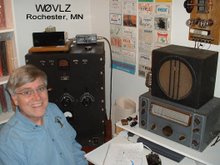
To see if I'm on the air right now click here
Showing posts with label AWA 1929 CW Contest. Show all posts

Wednesday, November 5, 2025

Bruce Kelley Memorial CW QSO Party

 In a few days this season's vintage radio events continue with the Bruce Kelley Memorial CW QSO Party. This will be two weekends using 1929 transmitters on the air. See https://www.antiquewireless.org/homepage/bk-qso-party-details/ for details.

The last few days I've been testing my Push-Pull Colpitts transmitter on 40 and 20. It sounds pretty good running 5-6 watts out. I'll probably be on 40 in the evenings and 20 in the afternoons.


More construction information here:

https://w0vlz.blogspot.com/search/label/1930%20TNT

 https://w0vlz.blogspot.com/search/label/1928%20Hartley

 https://w0vlz.blogspot.com/search/label/1934%20Colpitts 

73,

Niel - W0VLZ


Thursday, November 21, 2019

AWA Bruce Kelley 1929 CW Party - 2019

Another BK is in the log. This year I worked ten other '29 stations. K0SM/W2ICE was worked outside of the party hours so Andy does not show up in my official BK log.

It was interesting that half of the '29 stations I worked were in MN and they all had, by far, the strongest signals. My 80 mtr antenna is only 15' off the ground. I suspect it was working well as a NVI antenna covering the "locals" fine. After trying all I could think of to clean up my 40 mtr signal I still wasn't satisfied so I stuck to 80.

My BK station stayed pretty much as planned for the first part of the BK using my new push-pull Colpitts and 1940 homebrew simple super but I felt I wasn't hearing as well as I might plus I was having trouble zero beating my own signal. I cobbled in my Drake 2B after the first night.  It helped but contacts were still pretty slow. I also noticed a lot of signal wobble because of wind. I see all of my MN compatriots are running MOPAs. They may have a point.

What's next? The ARRL Straight Key Night on New Years Day followed almost immediately by the AWA Linc Cundall Memorial CW Contest.


Friday, October 11, 2019

Winter Operating Events

The first of this winter's Classic/Boat Anchor Radio operating events is on the  horizon, only a few weeks away. I've been working on rigs since last spring. Now I'll have more chances to put them on the air.

First up is the AWA Bruce Kelley Memorial CW QSO Party in early November. This one requires that transmitters be of 1929 or earlier design and use tubes available in 1929. I'll use my Push Pull Colpitts with either an SW3 or my Simple Superhet. If things get really tough I'll move my KX3 over for the receiver.


Next is the ARRL Straight Key Night on New Years Day (UTC). This is ARRL's "Uncola" of contests (Does anyone remember those Uncola 7 Up ads?). It runs for 24 hours and has no scoring, only interesting QSOs. I'll probably bounce between several rigs but I think I'll have my Drake 2NT and R4B running as the primary station.


Right after SKN, in mid January, is the AWA  Linc Cundall Memorial CW Contest. In this one extra points are scored for rigs designed before 1950. I've three stations that would fit but I've just gotten my National FB7 checked out and running again. I'll operate it with my "CW Jr" as a 1934 station.

Next is the Novice Rig Roundup. The NRR emphasizes rigs from the early Novice era when novices had to be crystal controlled and run only 75 watts. My Heathkit HW16 is newer for me so I'll run it on 80 and 40 for this event. The backup receiver will be my KX3.


Finally, the AWA John Rollins Memorial DX Contest is in mid-March. This one emphasizes contacts on 40 and 20 using rigs designed before 1960. I'll have a chance here to use my Collins 75A4 with my Eico 720. This may not be a real DX station but, for me, it has a lot of class. 


Listen around and participate. All of these except the
Bruce Kelley Memorial CW QSO Party allow you to join in using modern gear . If you hear me give me a call. 

This winter should be a lot of fun.


Wednesday, January 3, 2018

AWA Bruce Kelley 1929 QSO Party

The 2017 AWA Bruce Kelley 1929 QSO Party wrapped up a few weeks ago and tonight is the 2018 AWA Linc Cundall Memorial CW Contest.

My total for the BK was nine contacts covering both 80 and 40. For me, nine is better than some years and worse than others...sorta of average. It could have been better, though.

The first evening of the BK I had an S8-S9 noise level here. I blamed the poor band conditions of late and soldiered on working only KB0ROB that first night. Sunday afternoon I decided to make certain the noise was really not my problem. With a battery powered receiver on 40 meters I killed all of the power to the house. Surprise, my noise dropped from S8 to S3. Eventually I traced the problem to the wall wart charger for a new Dust Buster. I had time for one more contact that first afternoon. Unfortunately band conditions weren't as good this last weekend but, at least, I know it wasn't my problem.

Saturday, December 9, 2017

Signal Quality

I've read in the late 20s QSTs of the need to lightly load a self excited oscillator-transmitter (such as many of us use in the Bruce Kelley) in order to have a nice sounding signal. See https://w0vlz.blogspot.com/2009/11/ross-hulls-qst-article-documents-lot-of.html. Ross Hull concluded that any self-excited oscillator should be loaded to only about half power in order to produce at acceptable signal.

How bad do I sound? Might I rate one of those notices from an OO? When I try to listen to my own signal I'm always overloading the receiver and my signal sounds really bad. Instead I called upon my good friend KC0P who lives about 3 miles from me to listen to me and record what he hears.

Here are three snippets from that QSO using my PP 210s TNT transmitter:

- 3565KHz at 4 watts into a low endfed wire:
Click here
- 3565KHz at 8 watts into a low endfed wire:
Click here
- 7115KHz at 8 watts into a 32' vertical with two radials:
Click here

This really pointed out some weaknesses and strong points of my '29 station. First, this station really is more stable and sounds much better on 80 rather than 40. Next, upping the power on 80 from 4 to 8 watts does make a difference in quality but that difference is not real noticeable.  Finally, pushing this transmitter/antenna to 8 watts on 40 produces a noticeably bad signal. For tonight I'll run 8 watts on 80. I'll have some '29 character but not enough to rate an OO notice. On 40 I'll back off to 4 watts while limiting operating to the late evening. Next week I want to try different power levels and antennas on 40 to see how much things can be improved.

Friday, December 1, 2017

AWA Bruce Kelley 1929 QSO Party

Coming up in a little over a week is the AWA Bruce Kelley 1929 QSO Party. See http://www.antiquewireless.org/bruce-kelley-memorial-cw-qso-party.html .

My 2017 "BK" station is built around a   TNT transmitter using 210s in push-pull.  With it I'll use a two tube regen and/or Elecraft KX3 depending on band conditions.

In the front left of my BK operating position is a small table-top rack holding the two receivers plus an audio output transformer connected to a battery powered amplified speaker. Like many early receiver designs my regen has B+ flowing through the headphones. The external output audio transformer makes it safe to use and allows connecting to my amplified speaker. The regen B+ supply is off to the left. I use a power supply built from an Antique Electronics Supply kit. Sitting on the ledge behind the receivers is a regulated high voltage supply. This provides B+ for my transmitter. The TNT transmitter is sensitive to B+ voltage swings. This regulated supply helps control the "whoop". Next to the power supply is a Simpson Wavemeter. This allows me to easily get my transmitter in the band. Exact frequency setting of both the transmitter (and the regen) is done using my KX3 as a frequency monitor. Next is my TNT transmitter. This one is fairly stable and produces a nice note on 40 and 80. I can see why QST featured it in 1930. To the right of the transmitter is a plate current meter. This year BK is limiting input power to 25 watts and power is part of the QSO exchange. This meter is needed for accurate reporting. The wooden box on the far right is my filament supply. It provides both 7.5 volts to the transmitter and 2.5 volts to the regen receiver. On top of the filament supply is a QRP watt meter. This is handy for setting up the transmitter for maximum output. The switch on the table switches the antenna between transmitter and receiver. The key is a Kent Straight Key used for several years by my mentor/step-father K5CF (SK). Optional equipment includes a good cup of coffee, useful while trying to make those late night contacts with the east and west coasts.

In the backyard are my winter 80/40 mtr vertical and 95' inverted L antennas.

Counting down to the 2017 AWA BK

Thursday, November 30, 2017

Winter Contest Season

With cooler weather my operating has moved indoors. Here in Minnesota it's a little cold for QRP in the park. Now I'm on the air using my boat anchors in the basement. Real radios keep you warm in the winter.

December kicks off the winter contest season for me. This is the month for the AWA Bruce Kelley 1929 QSO Party. See http://www.antiquewireless.org/bruce-kelley-memorial-cw-qso-party.html . This QSO Party has a strict equipment requirement that sets it apart of most other ham radio operating events. Any transmitter used must be of 1929 (or earlier) design and use tube types available in 1929.

The ARRL sponsors Straight Key Night on New Year's eve and day. See http://www.arrl.org/straight-key-night . Participants are encouraged to get on the air and simply make enjoyable, conversational CW QSOs. While not specifically oriented towards vintage gear it is certainly boat anchor friendly.

The AWA Linc Cundall Memorial CW Contest occurs in early January. See http://www.antiquewireless.org/awa-linc-cundall-memorial-cw-contest.html . Here the objective is to contact the greatest number of participating stations using pre-1950 designed gear.

 In early March there will be the Novice Rig Roundup. This is a nine day operating event encouraging the use of vintage ham radio equipment from the early era of the Novice License. See http://novicerigroundup.com/ for the details.

 During the last few days of the Novice Rig Roundup, if you are looking for another contest/event in which to use that novice gear, there is the AWA John Rollins Memorial DX Contest. See http://www.antiquewireless.org/awa-john-rollins-memorial-dx-contest.html . It is open to all and runs on 40 and 20 meter CW. Pre-1960 equipment, such as 1950s novice gear, earns a multiplier and also various power levels including below 75 watts, the original "Novice gallon".

Sunday, December 25, 2016

AWA BK 1929 QSO Party Recap

The AWA Bruce Kelley 1929 QSO Party wrapped up a week ago. Unfortunately I had a fairly small window of opportunity here for operating. I did make 5 contacts, though. All in Minnesota and Wisconsin.

Listening to my signal on my 75A4 I thought it sounded pretty good with just a hint of a musical tone due to antenna sway. Certainly it was up to 1929 standards but with enough personality to be recognized on today's ham bands.

Click here


Now I'll start working on my station for the AWA Linc Cundall Memorial CW Contest. See http://www.antiquewireless.org/awa-linc-cundall-memorial-cw-contest.html

Thursday, December 15, 2016

AWA Bruce Kelley 1929 QSO Party

Last weekend and this coming weekend was the AWA Bruce Kelley 1929 QSO Party. For this event only transmitters of 1929 (or earlier) design/technology are allowed. I try to participate every year. See http://w0vlz.blogspot.com/search/label/AWA%201929%20CW%20Contest .

This year I again started out trying to get my Hull Hartley to sound reasonable on 80 and 40. See http://w0vlz.blogspot.com/2009/10/more-1928-hartley_21.html Somehow since 2009 something has changed giving my Hartley a raw AC buzz and some signal drift. Swapping out parts/tubes and cleaning all of the contacts did not help. As a final effort I moved the entire station away from the shack outside wall (nearest the antenna). It still drifted and had a  T7 to T8 tone...it went back on the shelf and down came my trusty TNT.

This coming weekend I plan to be on 80 with my  210 x 2 TNT running 10 watts in and about 3 watts out. The receiver will be my KX3 with PX3 panadapter. I've given up on using a vintage receiver for the BK. 80 meter noise is pretty loud here. I need all the help I can get to hear anyone. Visible in the photo besides my TNT transmitter and KX3 receiver with PX3 panadapter is the backside of my regulated HV power supply. The wood box visible in the near left encloses my 2.5/7.5 V filament supply. In the milk crate is a QRP watt meter and Triplet milliampere meter. Notice that I have a shaft extension on my TNT transmitter. This rig is sensitive to hand capacity. Moving my hand close to the normal tuning knob changes the transmitter frequency making it difficult to zero beat another station without this extension.

Thursday, February 11, 2016

TNT (and Hartley) Notes

Recently I pulled two early draft papers out of my files that, I believe, were written by W2SN in the early 80s.  One was "The Saga of the TNT Transmitter" and the other was "Additional Notes on Self-Excited Oscillators". I posted these at  https://www.prismnet.com/~nielw/W2SNPapers/Saga_of_the_TNT_Transmitter.pdf  and  https://www.prismnet.com/~nielw/W2SNPapers/Additional_Notes_Self_Excited_Oscillators.pdf   .

The 1986 Callbook lists W2SN as Vernon Clifford, Amityville, NY. He got into ham radio in the early 30s using a TNT transmitter. Almost 50 years later he decided to build an exact replica of his first rig. Finished, it looked good but when he put it on the air he got a T7 report with a bad chirp. In these two papers he details what he tried (and learned) as he attempted to clean up his signal.

Most of us have had a much better experience with the TNT transmitter than W2SN but I've heard some pretty crummy signals also. There is no doubt that the TNT circuit can misbehave with no one "silver bullet" fix but W2SN tried a lot of fixes and nothing seemed to work.  My TNT transmitter certainly sounds better on 80 than on 40. Perhaps most of W2SN's testing was on 40 or, heaven forbid, 20. He also never showed the layout of his transmitter. Perhaps there was a basic problem there.

W2SN does make several points beyond the typical TNT transmitter construction/setup instructions to look at including:
  • Try DC versus AC on the filaments
  • If AC filaments, check that the center tap resistor is centered
  • Bypass and/or choke the power and keying leads to minimize stray pickup
  • Don't use a wood (or wood filler) grid coil form
  • Insure a well filtered and stiff B+ supply
  • Tune the antenna network to minimize RF in the shack 
  •  Insure a good station ground to minimize RF in the shack
 W2SN also identified these potential issues. Comments?
  • The value of the grid leak
  • The value of the filament bypass capacitors
  • Bad feedback stability due to changing tube grid-plate capacitance
W2SN's final solution was to use a Hartley. In his case he needed to take this drastic measure. This solution does not necessarily apply to all of us.

My TNT transmitter shows some (if not all) of the same problems that W2SN saw on 40 mtrs but sounds fine on 80. Next fall I'll look at some of the areas that W2SN mentioned to see if I can get a better signal on 40.

( Have you seen a polished version of these articles? If so, please let me know.)

Thursday, December 10, 2015

A Winter Vertical

Each winter I shift my primary operating from QRP in the Park to Boat Anchors in the Basement. Two of my favorite winter operating events are the AWA Bruce Kelley 1929 QSO Party and the AWA Linc Cundall Memorial CW Contest. Both of these focus on boat anchors running on 160, 80 and 40 meters. My permanent shack antenna is a trade off at best. I don't have a good way to get much height.  For the past several years I've played around with a temporary/winter vertical.

This year I used 7 4' sections of military surplus
fiberglass tubing plus a 5' whip as a 40 meter quarter wave vertical. It is attached to the deck railing at the 9' level and guyed at 24'. I added a loading coil at 13' to get it resonant on 80. This coil is bypassed for 40 meter operation.

After looking at my 80/40 meter vertical I thought, "Hey, I like to operate on 20 also. Let's add a 20 meter quarter wave wire"; good on paper but bad idea. Both the 80/40 meter wire and the 20 meter wire are connected in parallel at the bottom of the vertical. The 20 meter quarter wave wire runs within an inch or two of the 80 meter loading coil. This wire couples into the loading coil changing the resonant frequency by 100-200 KHz...and the resonant frequency varies if the wire flops around in the wind at all. I could watch the
SWR shift as I held the key down. In addition this loading shift really ruins my 29 transmitter tone/signal. Solution: remove the 20 meter element. My winter vertical works fine on 80 and 40 meters, perfect for the AWA operating events.

Some might notice the knotted
rope and pulley attached at the 24' level. For the last two weeks of December and the first days of January my vertical is re-purposed for Christmas decorations. We run a lighted star up it with an attached "tree" of lights.

Saturday, December 20, 2014

2014 Bruce Kelley 1929 QSO Party

It was an interesting Bruce Kelley 1929 QSO Party this year. I learned a little more about using my own 1929 equipment and greater appreciation for the skill of those hams 85 years ago.

Getting my SW5 on the same frequency as my transmitter was the greatest challenge.
Fortunately I could tune my KX3 to my transmitter frequency using the KX3 as my code/signal monitor and then get the SW5 on frequency by tuning it and listening for the KX3 local oscillator.

I was never totally satisfied with the stability of my Hartley but, in reality, it may have been good enough of the BK. At the last minute I switched it out for my TNT. My TNT is a push-pull design with two tubes is push-pull across the tank circuit. Any inter-electrode capacitance change is cut in half so drift due to this capacitance change is also cut in half.

As mentioned earlier I tamed my SW5 considerably by converting the tuned RF stage to an untuned RF stage. This required only plugging a new "coil" consisting of an RF choke and capacitor.

All in all I made 16 contacts on 80 including Maine, British Columbia and North Carolina....not too bad for my 2-3 watts into a low endfed wire.

My friend W7BGO caught me on the air and recorded two of my QSOs, one with K0EOO and the other with KE0Z.

Listen to recording of my QSO with K0EOO and his 1926 Hartley:

Listen to recording of my QSO with KE0Z and his 1929 Hartley:


Thursday, November 6, 2014

2014 Bruce Kelley 1929 QSO Party

I'm making progress with this year's 1929 QSO party station. The SW5 works OK but I wonder if the grounding may have gone bad over the years. Nothing in the 1930's SW-5 literature hints at the sort of microphonics and feedback that I'm experiencing. I've tested the bypass caps by substitution and tightened all of the nuts/bolts I find with no change. Running it with an untuned RF stage seems to be the biggest help. Next is powering up my 1928 Hartley.

Pictured is my SW5 at the operating position and Hull Hartley on the window ledge. My Hartley tends to be microphonic because of the tank circuit construction. It can't sit on the operating table because just pounding on the key will be transferred to the transmitter causing the signal to wobble. The window ledge sits on the cinder block house foundation. it shouldn't be going anywhere. I'm using a National 5880-AB power supply (recapped, fused and cord replaced) with the SW5. The regulated power supply is for the Hartley...anything to make the signal as stable as possible. Also part of the station is my Elecraft KX3. The BK recommended operating windows are only 25 KCs wide, just a couple of dial divisions on both the SW5 and the Hartley. The KX3 will be my frequency meter and backup receiver.

Friday, October 24, 2014

2014 Bruce Kelley 1929 QSO Party

This year's AWA 1929 QSO Party is only about  1 1/2 months away.
The Feb 1931 QST cover inspired me to pull my SW-5 off the shelf to pair with my Hartley transmitter.

I found feedback within the SW-5 to be a problem. This isn't too bad for casual listening but it is a real problem for  on-the-air operating. Checking through my QST files I found the James Millen Sept 1931 article describing the design process for the SW-3. In it he talks about various shielding options. The SW-5 shielding looks a lot like Millen's first attempt at SW-3 shielding. He described the results as "most disappointing" and "the RF stage oscillated violently". My no holes solution? Turn the tuned SW-5 RF stage into an untuned RF stage. I inserted an RF choke and an antenna coupling capacitor into an empty SW-5 coil form and use it instead of a standard RF stage coil. Now the SW-5 RF stage stays out of oscillation and it still picks up plenty of 80 and 40 meter signals.


It looks like I may be able to use my new QSL cards after all.

Friday, December 20, 2013

1929 BK QSO Party

The past two weekends I spent 4-5 hours operating in the BK. I had 16 QSOs
and worked five states including NC, MT, MI and ME. Background noise levels were pretty high but even with about 2 watts out I still made contacts.

I'm not pleased with the way my TNT transmitter sounds on 40. After an initial excursion into that band on Dec 7 and then critically listening to my own signal I decided to stick to 80.

Friday, December 6, 2013

1929 BK QSO Party

I'm set up for the AWA Bruce Kelley 1929 QSO Party. This year I'm using my TNT transmitter with two 45 triodes in push-pull .  This transmitter has an output of only 2-3 watts with 10 watts input, about typical for self excited oscillators like this connected directly to the antenna. At first I thought I'd also use a vintage receiver but I switched to my KX3.

Tonight I did work KK4HCF in TN and WA1KPD in CT  heard me so there is hope for the QSO Party.

Monday, December 10, 2012

Bruce Kelley Memorial 1929 QSO Party

This past weekend I was able to put a 1929 transmitter on the air and participate in the AWA Bruce Kelley Memorial 1929 QSO Party.

I stayed on 80 meters making 18 contacts. Stations worked were as far west as VE7SL in British Columbia, as for east as N1BUG in Maine and even a little south to N4GJV in North Carolina.


This year I used a transmitter I acquired from Vance, K5CF (SK). Vance, my step father, gave me my novice test in 1966. He enjoyed ham radio for over 70 years. Several years ago Vance encouraged me to participate in the 1929 QSO Party. Vance's transmitter is a TNT (or Tuned plate Not Tuned grid) transmitter using a single type 210 tube. With 340 volts on the plate it runs 9 watts input and about 2 watts out. Vance built his transmitter based on the one Bill Orr described one in the January 1973 issue of CQ but the original design dates from the 20s. See the December 1929 issue of QST for George Grammer's version of the same transmitter. For an antenna I used a 105' end fed inverted L only about 15' off the ground.

Wednesday, December 5, 2012

Bruce Kelley Memorial 1929 QSO Party Preparation

Last night I set up my station for this year's AWA Bruce Kelley Memorial 1929 QSO Party. I decided to go with my TNT transmitter this year and, as a book end for ham technology, pair it with my Elecraft KX3 running as the receiver. With 275 volts on the 210 plates my TNT transmitter runs at just under 10 watts input. Output is 2-3 watts....about to be expected for this sort of transmitter.

After confirming via the Reverse Beacon Network that I was indeed getting out on 80 I tried a QSO this morning. I worked W4DBV near Nashville, TN. When quizzed about my signal Bryan reported:

 "I can't really assign your tone a number, and my verbal description is about as close as I can come.  I have heard much worse, and I have also heard other rigs that are about the same as yours -- usually vintage or HB vintage designs, most running QRP levels of power.  Your note did not have a frank buzz, I can say that."

While not the best signal report it will certainly do for this weekend. In the meantime I'll play with the loading to see if I can improve it a little.

Monday, December 12, 2011

AWA Bruce Kelley Memorial CW QSO Party

The last two weekends I operated in the AWA Bruce Kelley 1929 QSO Party. This is always a great time to get an early rig on the air and work others doing the same.

On the first weekend I operated as K5CF from Poteau, OK using Vance's type TNT transmitter running about 6 watts using a single type 10 tube. While I heard W0LS, KB0RON, N8YE and KB0MM fairly well I could never get a response to my calls. Power out looked OK so Vance's Gap Titan DX vertical on 80 may have been the problem.

This past weekend I was back in Rochester, MN using my Hartley transmitter to make ten contacts. This event allows any receiver to be used. This year I used my 1941 simple superhet. I have only a fairly low end fed wire antenna and my contacts reflected this. Seven were right here in MN, two were in OH and one "DX" contact was in SC.

What might I change? The antenna is always an issue. I have a 29' base loaded vertical this winter but the recent snow seems to have detuned it. I'll need to check it out before the LC CW Contest in January.


Friday, October 28, 2011

On the Air with my Hartley

The AWA 1929/Bruce Kelley CW Party is coming up the first two weekends in December and the weather has started to cool off here in Minnesota. I've put the K1 back into it's winter operating position (a top the 75A4) and started to warm up the classics.

Right now I'm running my Hartley paired with my 1940 Simple Superhet. They make a good pair but my signal reports remind me of one of the Hartley's main limitations. On the 18th I worked Lynn, NG9D. Lynn commented that my signal had a fast QSY to it. Last night I worked Dave, WA9DOF. Dave reported that he wouldn't have known the transmitter was a vintage rig if I had not told him. The difference was the wind. Last night we had no wind here while on the 18th the wind was 10-15 mph. The antenna blowing in the wind shifts the load slightly that it presents to the transmitter. This in turn pulls the frequency slightly. Lightly loading the rig when tuning up helps (see my Nov 16, 2009 Blog entry) but wind can still be a factor. Pulling my wire antenna tighter or a completely new antenna might be needed. I'll see what I can do.