Last weekend I attended the TwinsLAN/3M swapmeet in St Paul, MN. This is always one of my favorite swapmeets of the year. It is open-air in a large parking lot so all of the boatanchors show

up that we don't want to lug inside to a table...just throw open the van doors or uncover the pickup bed and sell.This year I saw many more boat Nationals, Hallicrafters, Johnsons and Heathkits than I've seen in the past...it was a great meet.
One item caught

my attention, a late 40's United Surplus Materials "Mity Mite" HF radio. It is a three tube regenerative receiver/transmitter. The audio stage of the two tube receiver doubles as a single tube crystal controlled oscillator/transmitter. The third tube is a rectifier. I bought it from KB0DVM. He built and used this little rig while he was an Ag student at U of Wisconsin/Madison in 1948.

This is a great example of a minimal design making use of available WWII surplus parts. The first steps in the instruction manual explain how the disassemble the included BC-745 pogo stick transceiver tuning unit to get the crystal, two sockets, a tuning coil and the bandset capacitor. The design itself would not make it off of today's drawing boards. First it is an AC-DC set with one side of the AC line connected directly to the metal chassis/cabinet...what a shocker! A safer (and more expensive) AC-DC design has circuit ground isolated from the chassis but not this one. A quick look at the operating instructions shows a note about not connecting an antenna ground but nothing about the shock hazard. Next there is no tuned circuit in the transmitter output. Any harmonics generated by the crystal oscillator are passed unattenuated to the antenna. Again not a good design but it works, though on several bands at the same time.
The Mity Mite is a pretty neat little radio that reflects the time and market it was designed for. It is a keeper. I'll probably figure out a way to put it on the air (while staying on one band and not killing myself).

 built around a single 572B running
 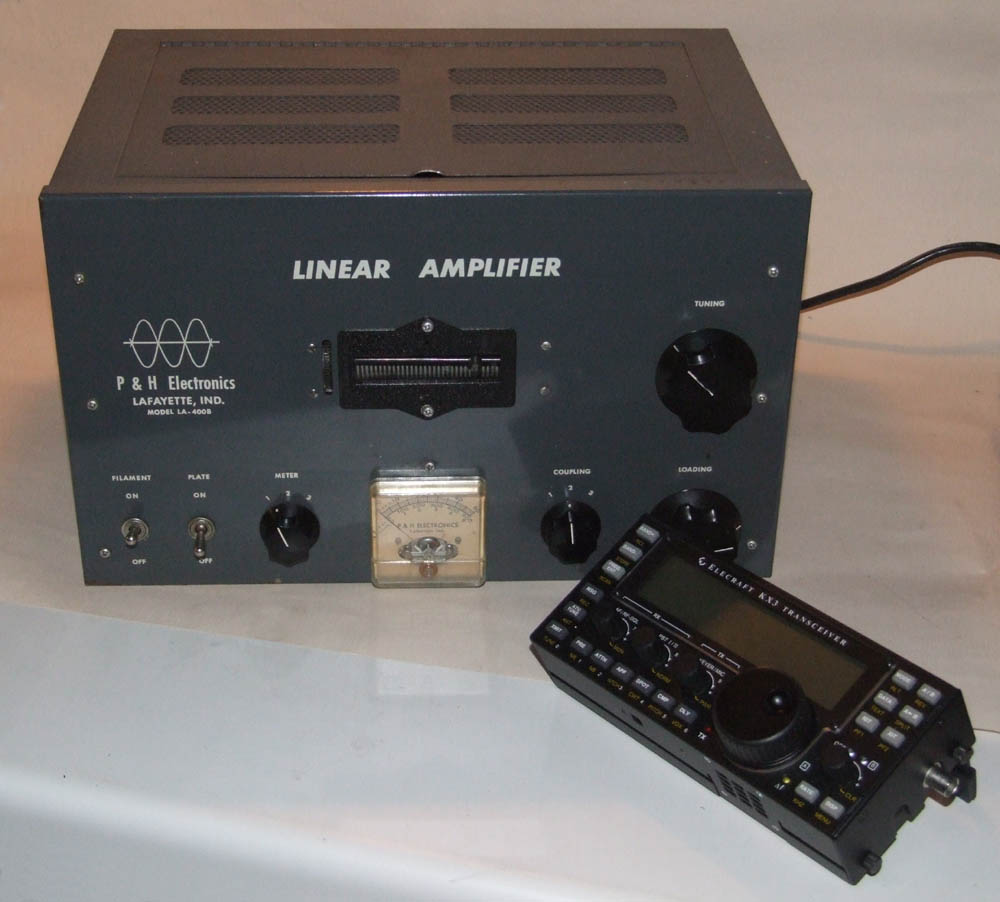 grounded grid. It matched my Central Electronics 20A and the seller
  At 35 pounds this one will be a heavy weight. I doubt it will see any picnic table operating but it will certainly help warm up the shack next winter.