To see if I'm on the air right now click here

Sunday, December 25, 2016

AWA BK 1929 QSO Party Recap

The AWA Bruce Kelley 1929 QSO Party wrapped up a week ago. Unfortunately I had a fairly small window of opportunity here for operating. I did make 5 contacts, though. All in Minnesota and Wisconsin.

Listening to my signal on my 75A4 I thought it sounded pretty good with just a hint of a musical tone due to antenna sway. Certainly it was up to 1929 standards but with enough personality to be recognized on today's ham bands.

Click here


Now I'll start working on my station for the AWA Linc Cundall Memorial CW Contest. See http://www.antiquewireless.org/awa-linc-cundall-memorial-cw-contest.html

Thursday, December 15, 2016

AWA Bruce Kelley 1929 QSO Party

Last weekend and this coming weekend was the AWA Bruce Kelley 1929 QSO Party. For this event only transmitters of 1929 (or earlier) design/technology are allowed. I try to participate every year. See http://w0vlz.blogspot.com/search/label/AWA%201929%20CW%20Contest .

This year I again started out trying to get my Hull Hartley to sound reasonable on 80 and 40. See http://w0vlz.blogspot.com/2009/10/more-1928-hartley_21.html Somehow since 2009 something has changed giving my Hartley a raw AC buzz and some signal drift. Swapping out parts/tubes and cleaning all of the contacts did not help. As a final effort I moved the entire station away from the shack outside wall (nearest the antenna). It still drifted and had a  T7 to T8 tone...it went back on the shelf and down came my trusty TNT.

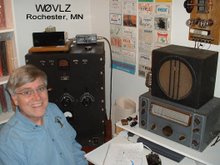
This coming weekend I plan to be on 80 with my  210 x 2 TNT running 10 watts in and about 3 watts out. The receiver will be my KX3 with PX3 panadapter. I've given up on using a vintage receiver for the BK. 80 meter noise is pretty loud here. I need all the help I can get to hear anyone. Visible in the photo besides my TNT transmitter and KX3 receiver with PX3 panadapter is the backside of my regulated HV power supply. The wood box visible in the near left encloses my 2.5/7.5 V filament supply. In the milk crate is a QRP watt meter and Triplet milliampere meter. Notice that I have a shaft extension on my TNT transmitter. This rig is sensitive to hand capacity. Moving my hand close to the normal tuning knob changes the transmitter frequency making it difficult to zero beat another station without this extension.

Friday, December 9, 2016

More on my 20 meter Endfed Zepp


I've always been a little worried about feed line loss in my portable antenna /  20 meter Endfed Zepp.

TV twin lead does have more loss then lots of other feed lines that may be used but it is light and we're talking about less than 15 feet of the stuff here. Estimates I've found on the web show .5 - 1 dB loss per 100' for dry, clean, matched TV twin lead. The loss for 15' then comes out around .1 dB. Since my intended use of this antenna is temporary QRP-in-th-Park sort of operating, keeping the twin lead clean and dry should not be a problem. If it's raining, I just QRT, packup and go home.

Loss due to mismatch at the antenna is the other issue. See K5DVW's Nov 2006 QST article posted at http://www.arrl.org/files/file/Technology/tis/info/pdf/q1106037.pdf Assuming that the EFHW wire presents a 3000 ohm load to the 300 ohm feedline then the SWR is about 10:1. Extrapolating off the left edge of K5DVW's figure 1 chart leads me to conclude that this 10:1 feedline mismatch adds another .5 dB loss for about.6 dB total. Feedline loss for 30' of RG-58 (about the most I'd want to carry any distance) feeding a matched dipole at 14MHz is .4-.5 dB.

It appears that the feedline loss difference between 15' of twin lead feeding an EFHW wire and 30' of coax feeding a dipole is negligible.

My classic 20 meter endfed zepp antenna with quarter wavelength feed does require a tuner. While in theory the feedline could be trimmed and stubbed to present a 50 ohm load to the transmitter (see http://www.mfjenterprises.com/antennatalk8.php ) it is sensitive to antenna configuration and adjacent objects. A tuner of some sort is required to take care of the variable mismatch, but, since it is close to 50 ohms, the tuner does not need to be "wide range".

So based on my observations for this antenna -
- Some sort of tuner is required (built into many QRP rigs these days)
- Feedline loss is essentially same as coax
- Allows flexible deployment (Vee, L, vertical, sloper)
- No ground (or radial or conterpoise) requirement
- Light weight
- Entire antenna system is off the ground
- Usually requires only one support
- Optimized for one band but usually can be tuned as a random length end wire for other bands

Friday, November 25, 2016

Thanksgiving Day Power Supply

After Thanksgiving Dinner this year I took the opportunity to make progress on the power supply for my 1939 transmitter.

I completed the  500 VDC and 7.5 VAC sections needed for the amplifier.  PSU Designer II indicated that I needed to allow for almost 2000 volts across each of the diodes in the bridge rectifier. I ended up using two 1000 PIV diodes in series for each leg of the bridge. This is a boat anchor power supply with silicon hidden under the chassis. It needed some glow. I added a type 80 rectifier connected only to 5 VAC so that it would look right. After all, real radios need to glow in the dark.


Eventually I'll add components to power the oscillator/buffer stage including 250 VDC, 150 VDC and 2.5 VAC. In the meantime I can drive the amplifier with either my Utah Jr or Meissner Signal Shifter.

Thursday, September 29, 2016

50 Years

Today I pulled my novice license out of the file. It reads "effective date: 09-23-66". Wow I've been hamming for 50 years...well, not quite. I also pulled my novice logbook out of the desk drawer.
It shows my first RF to the antenna was on Oct 16, but no answer to my CQ. Vance, W6ZZL, then got on using my equipment to show that I was getting out. He worked WN6UBL. It was almost 2 weeks before I had an actual contact. I worked WN7EQS on October 28.

It was a fun year as a novice but I couldn't quite master 13 WPM. I ended up with a technician license on 2 mtrs for a few months until I was able to upgrade and get back on HF.

I thought it would be appropriate to have a "50 Years of Ham Radio" QSL card to  go along with all of this. A few minutes with a graphics program and a quick order to Walmart got me what I was looking for.

Thursday, September 1, 2016

QSOs on a "Poor" Band

Today I was reminded that it never hurts to try.

Earlier this week Beth and I, after looking at the weather forecast and our calendar, decided to find something to do outside today. We finally settled on a day trip and picnic at Great River Bluffs State Park, about an hour east of here and overlooking the Mississippi. We could do a little hiking and then Beth could read while I did a little hamming (Don't all wives pack along a book in case the OM decides to get on the air?).

Great plan, but then I looked at the propagation forecast. Conditions for 20 meters, my favorite band for QRP in the Park was listed as "Poor". Shucks, why bother packing the KX3 along and putting up the antenna if no one will hear me. I was about to leave the rig behind and take my own book. In the end the KX3 did come and Beth and I found an operating/reading position about 600' above the Mississippi. There was shade for Beth and trees I that could get my antenna into without a lot of trouble.

For a poor band 20 was doing pretty good today. WA3GPM (PA) came back to my first CQ before I was even properly settled in my chair. I was expecting to review Reverse Beacon Network hits and instead I had a QSO. Before Beth got her book finished I had also had good QSOs with KB1CL (MA), N7DS (MT) and N1WPU (ME).

Never leave town without your rig...it never hurts to try.


Wednesday, July 6, 2016

QRP - Houseboat Mobile

For a few days at the end of June we had a family houseboat vacation.

It's been several years since I've operated houseboat mobile. The first was in 1992 operating on Shuswap Lake, BC using a Heathkit HW9 and Hustler Mobile whip antenna.
The second time was in July 1995 operating on Lake Roosevelt, WA using the same HW-9 but with an endfed wire antenna.

This time we were in Voyageurs National Park on the northern Minnesota / Canadian border. I used my KX3 and twin lead fed 20 meter zepp.

For the antenna support I had one of my 16' crappie poles strapped to the upper deck railing. My antenna is 34' long with a 14' feedline. With this support it formed an inverted V sort of antenna with the far end dangling off the end of the boat...a prime example of "any antenna beats none at all". I did manage some QSOs, though, working WG0AT, N6TEM, VE3TLO and KD8DEU.

I had hoped to get on a little for Field Day but June weather in the Upper Midwest tends to be a little unsettled. This June was no exception. On Saturday June 25 we had thunder storms in both the morning and the evening plus we were under a tornado watch that evening.

Saturday, May 21, 2016

Two (watts) Fer 20

I'm sorta on a twins kick right now. After building and using my 80/40 meter mid 50s QRP-in-the-Park Twins I looked around the shack and spotted my

Ten-Tec 1056 "Any Band" DC receiver that I had built several years ago for 20 meters. Unfortunately the 1056 is no longer sold by Ten-Tec but Pacific Antenna does sell the TwoFer 2 watt transmitter kit . I should be able to make it into an excellent "twin" for the 1056.

Monday, April 18, 2016

3S4 x 2 Transmitter and 1T4 / 3V4 Regen

I've gotten off to a slow start with my mid 50s QRP-in-the-Park Twins. So far only W3BBO in Erie PA has gotten one of my special QSL cards. Now, though, I'm back from a two week trip and ready to get on the air again.

Thursday, March 24, 2016

3S4 x 2 Transmitter (On the Air)


I've finished my mid 50s QRP-in-the-Park Twins. Today I put them together and got on the air....unfortunately no responses to my CQs, but my 1 watt signal was getting out.

The Reverse Beacon Network gave me hits as far west as Utah, south into Texas and east to Massachusetts, not real strong but I was copy-able. I'll try again tomorrow.